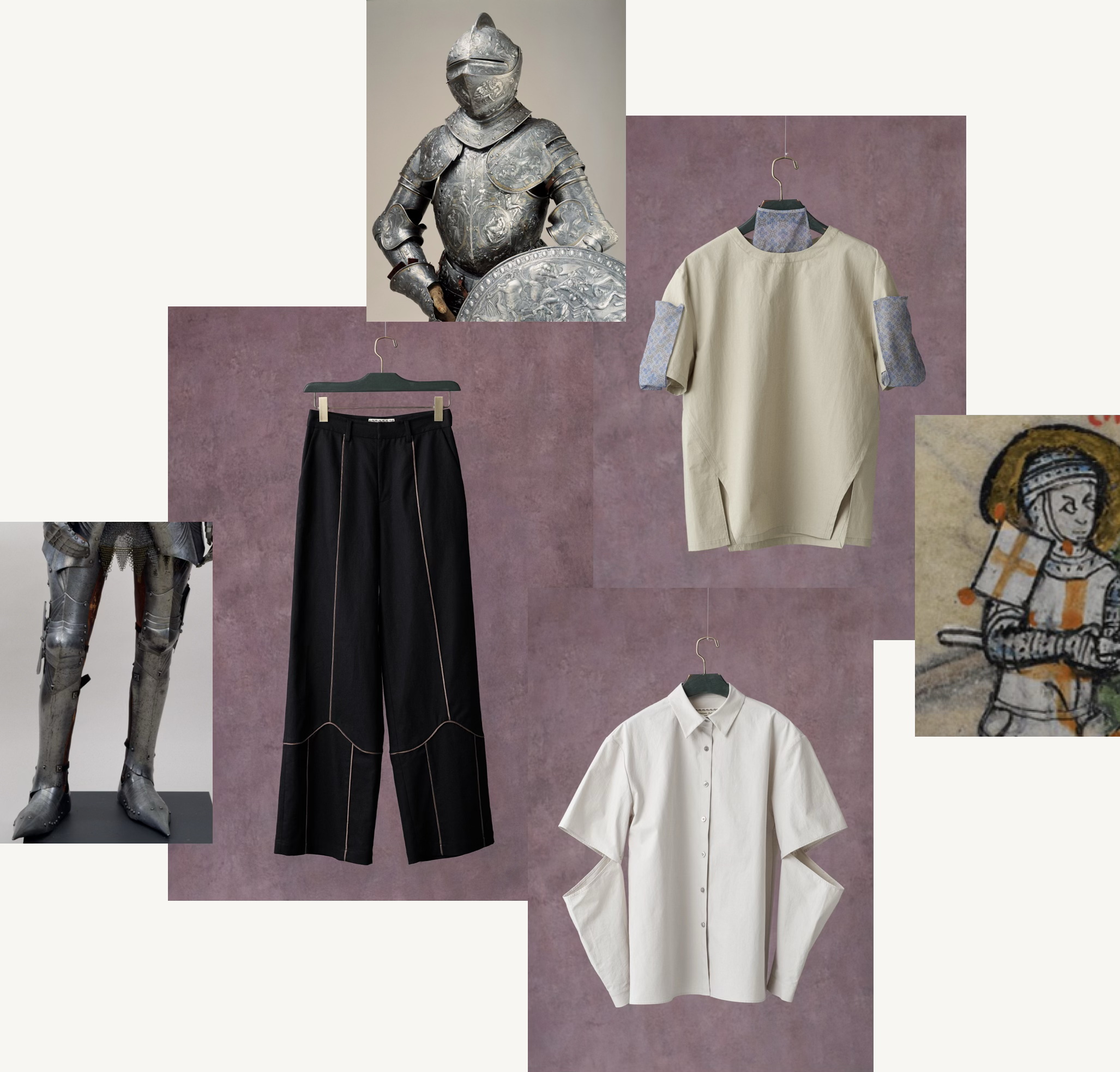
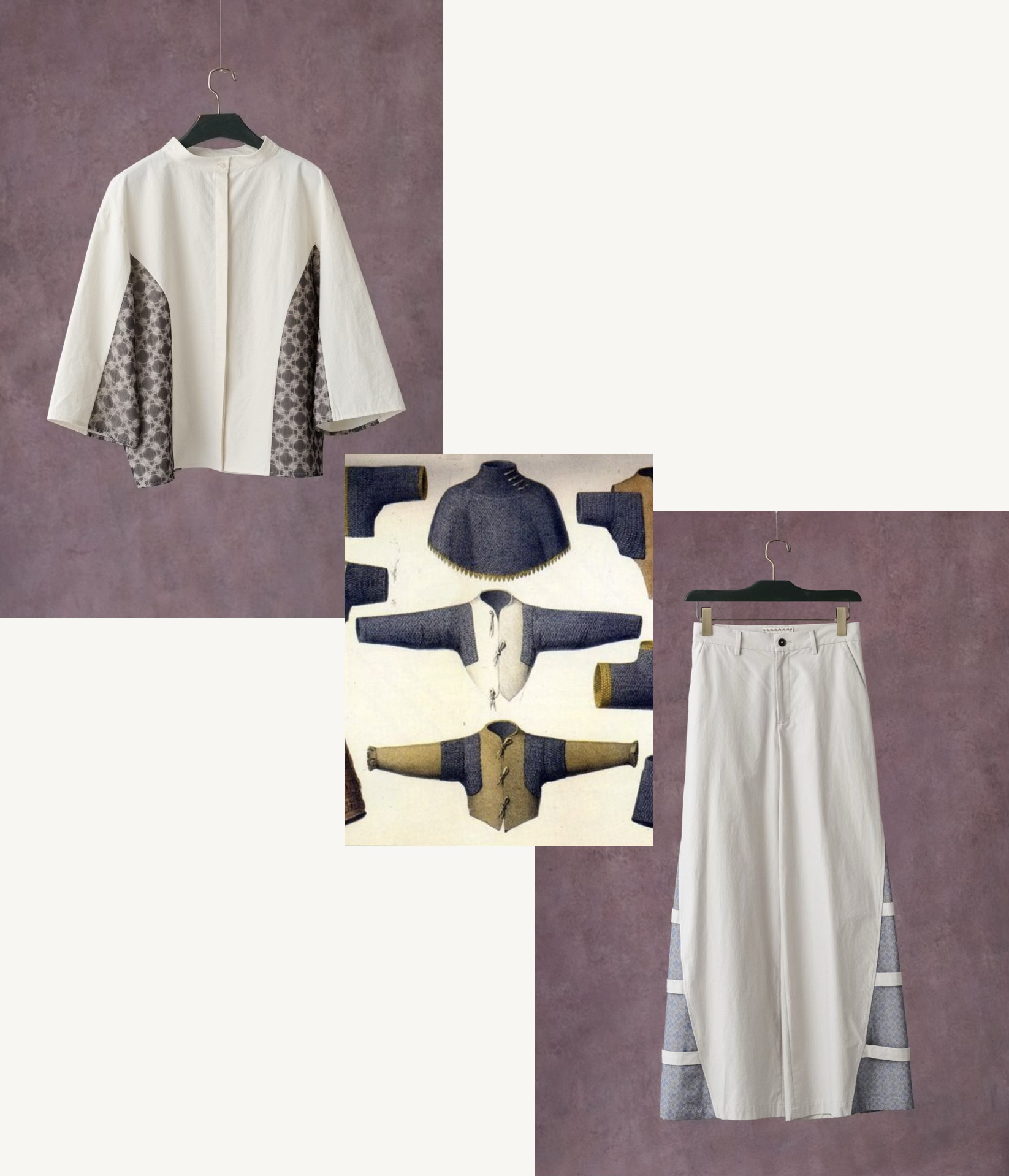
Plate armour gave us a starting point for thinking about how clothing surrounds the body. In Armed to the Teeth, we translate these solid surfaces into separable, lightweight elements: printed chiffon crepe placed around the arms and neck of a cotton top, or voile shoulder panels recalling the shape of ailettes.
Another approach to this reference is through the divisions between plates. Contrast satin lines interrupt the sturdy linen-cotton denim, tracing sections of the legs and suggesting places where an outer shell has begun to separate. The satin evokes the softness of underclothing, as though exposing a more intimate layer beneath the armour.
Lappet
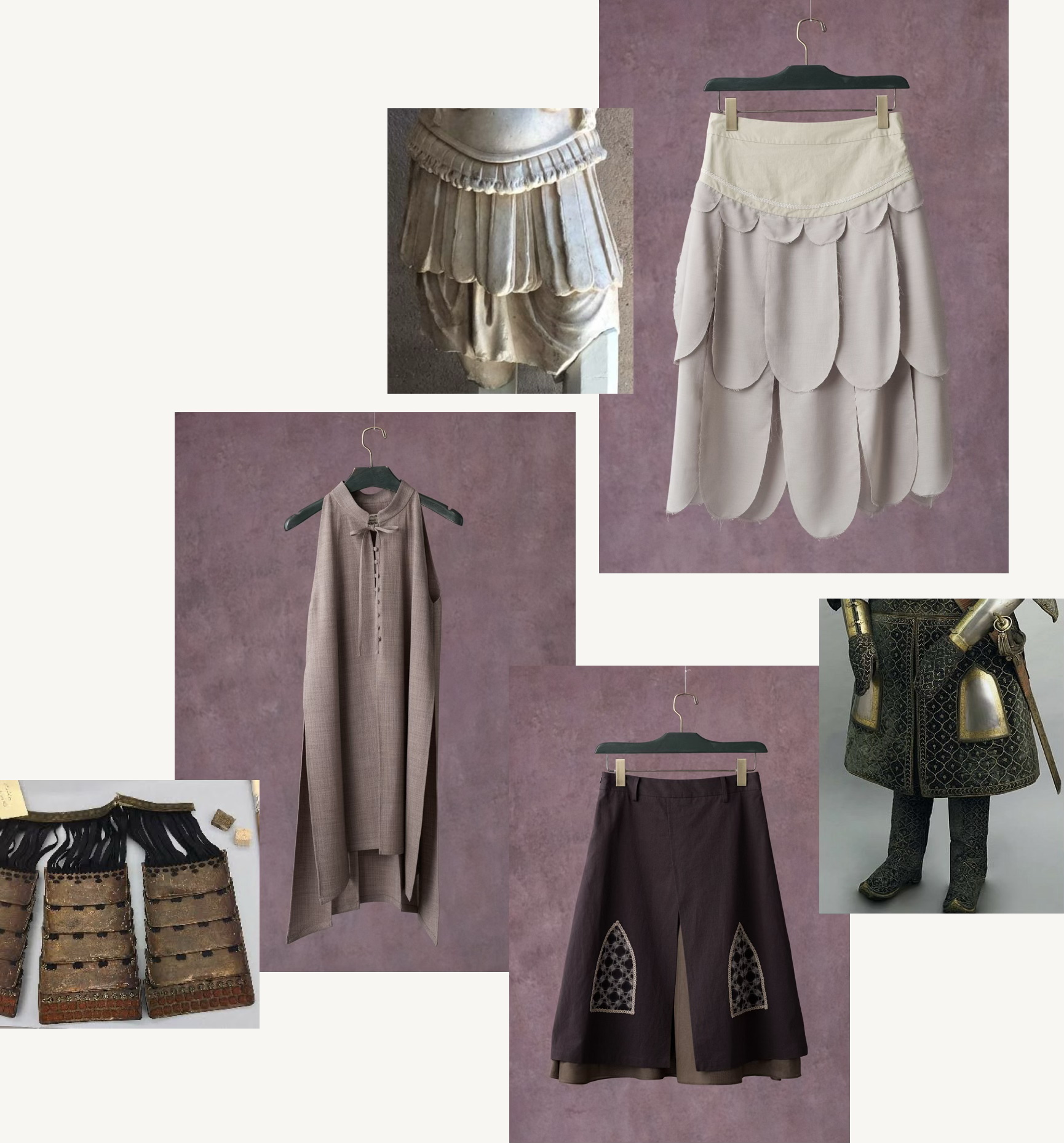
We are interested in the hanging elements of armour and the space they leave for movement. The hanging strips of Roman armour known as pteruges (‘feathers’) and the suspended panels of Japanese samurai armour offered references for a covering that could remain loose around the body.
These references become overlapping, rounded layers on the skirt and long, freely hanging panels on the top. From a distance, the geometric arrangement carries a certain firmness. Closer up, the lightness and fluidity of the fabrics would overturn that impression.
Dagging
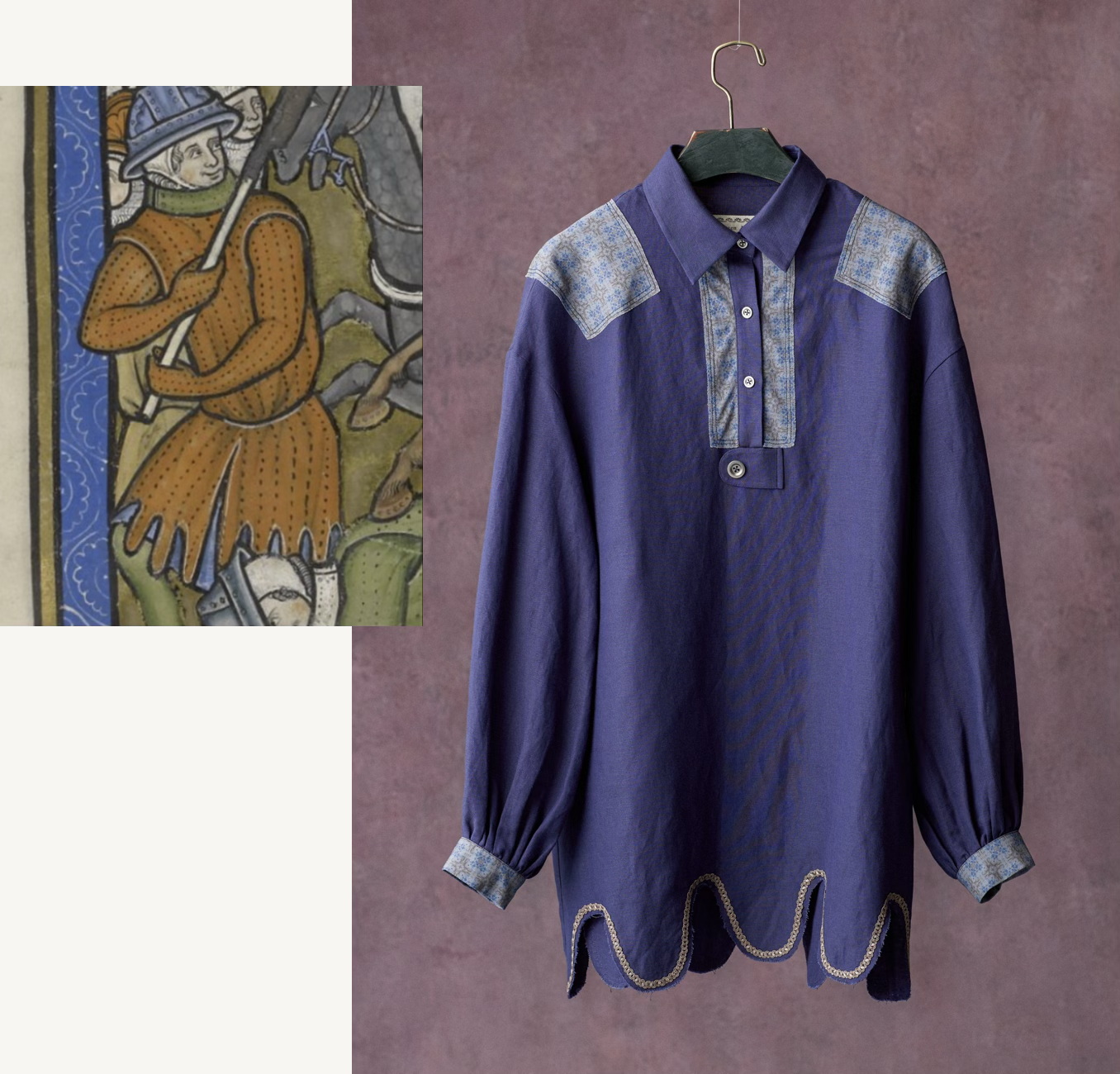
Dagging introduces a repeated sequence of shapes into the edge of a garment. We were drawn to the interrupted hem of a medieval gambeson, where the outline continues through a series of rounded extensions.
For this collection, we thought a lot about where a protective covering should end. On the Dagging Shirt, the idea appears in a shaped hem beneath a loose linen-rayon body. We decided that the lower edge should feel like a gradual transition, with its boundary softened by the repeated curves.
Laminar
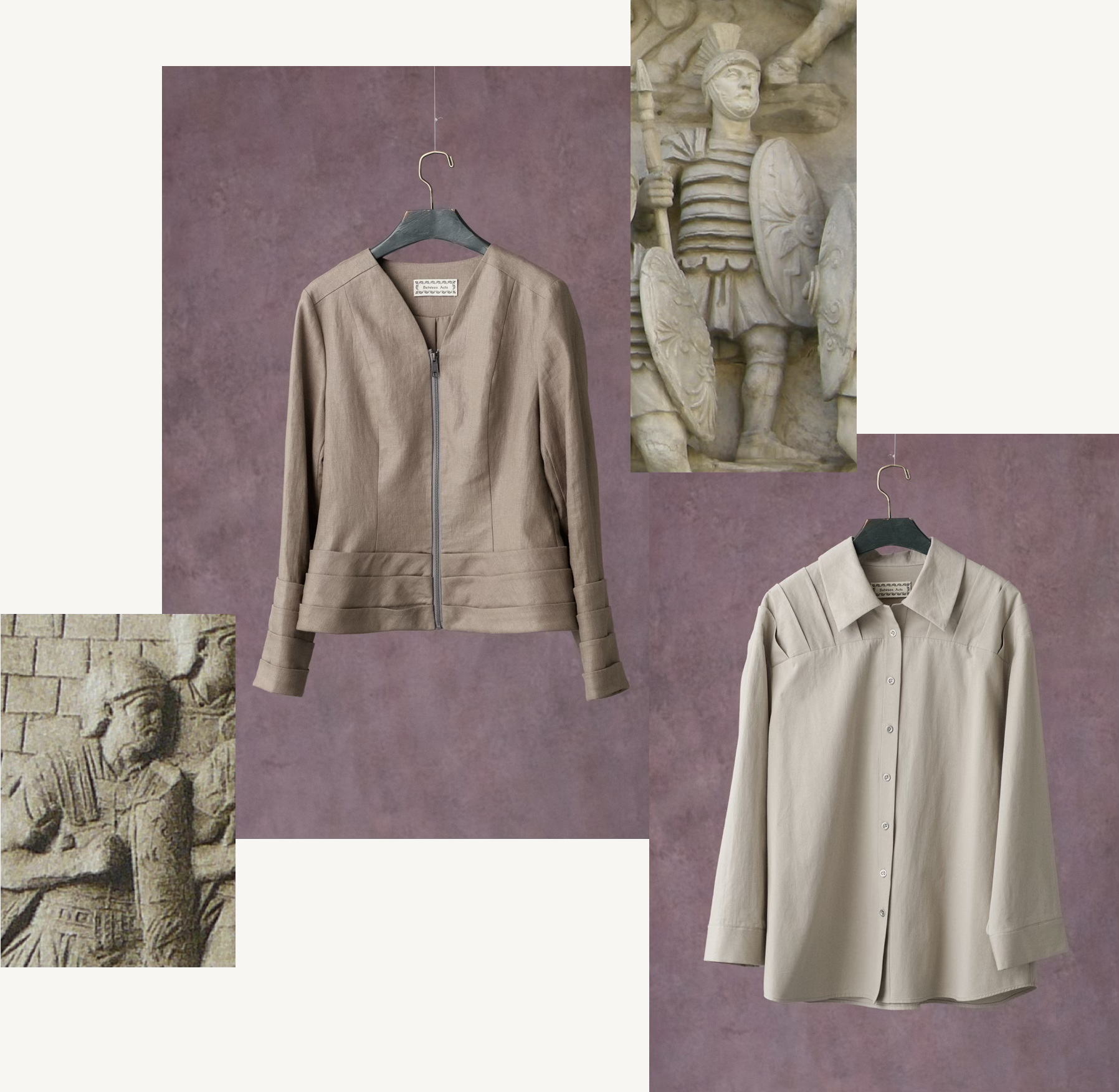
Laminar armour uses overlapping bands to form a protective surface that can bend with the body.
Across the jackets, the laminar reference appears in horizontal bands around the hem and cuffs, or in panels that fan across the shoulders. These repeated sections bring a layered rhythm to otherwise simple silhouettes. The Japanese linen brings its own softness to the reference.
Chainmail
The Chainmail reference enters here through the sides of an everyday shirt. We placed panels of printed chiffon crepe against high-density cotton, suggesting a light layer of protection.
The cotton is 荒炊き染め (aradaki-dyed) in Toyama, Japan, while the chiffon brings a more delicate quality to the side panels. With these fabrics, we want to present a state of preparedness within something easy to wear.
Body-wrap
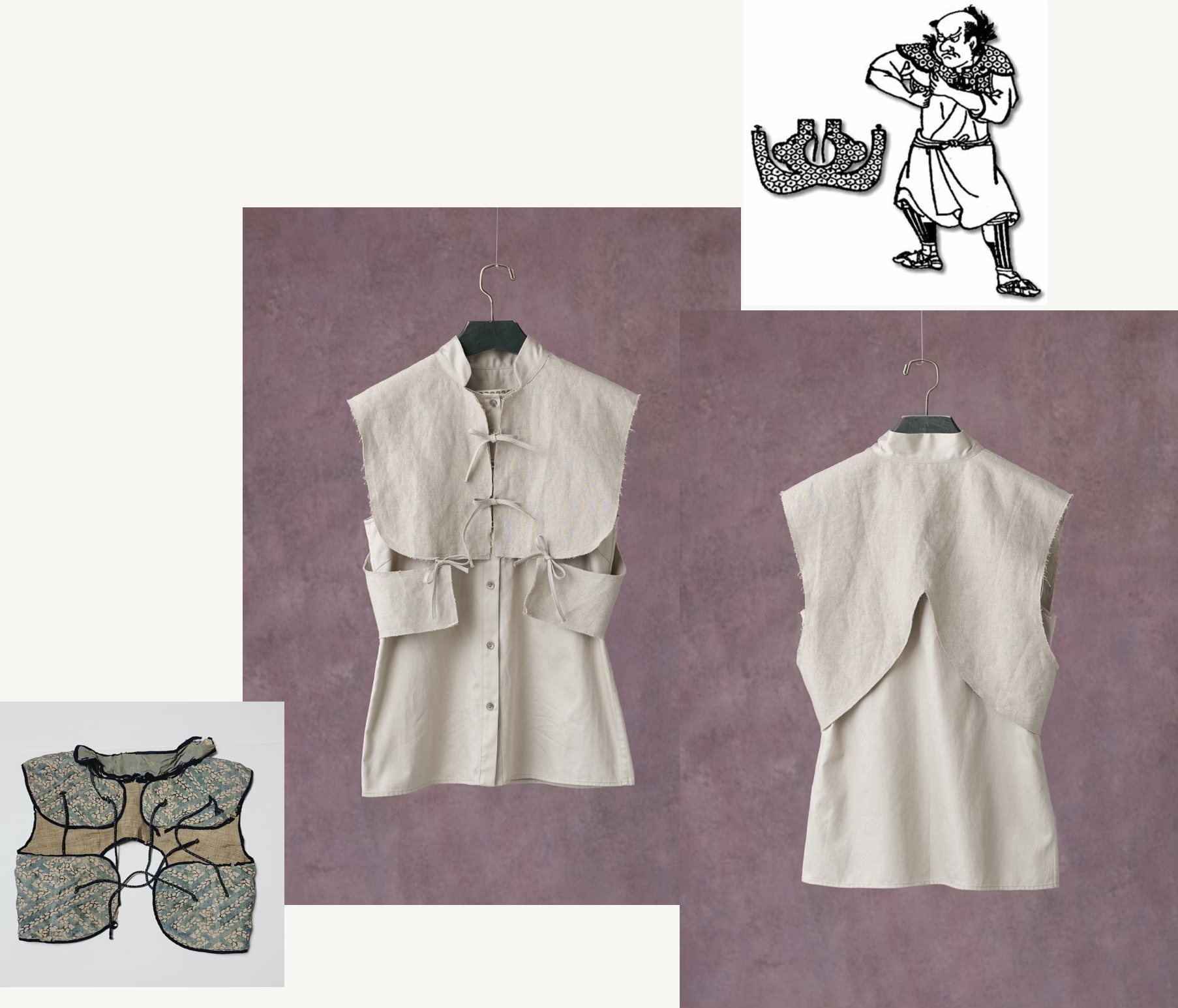
The Body-wrap shirt takes its shape from a detail in Japanese auxiliary armour 満智羅 (manchira): panels that reach from the back, pass beneath the arms, and fasten at the front. We liked how the same simple arrangement could hold the piece in place while protecting the underarms.
We then carried this into linen panels that wrap around a cotton satin shirt and tie at the front with ribbons. This combination of fastening and protection felt familiar to us, like a small, almost unconscious gesture of looking after oneself.
Mirror armour & Tasset
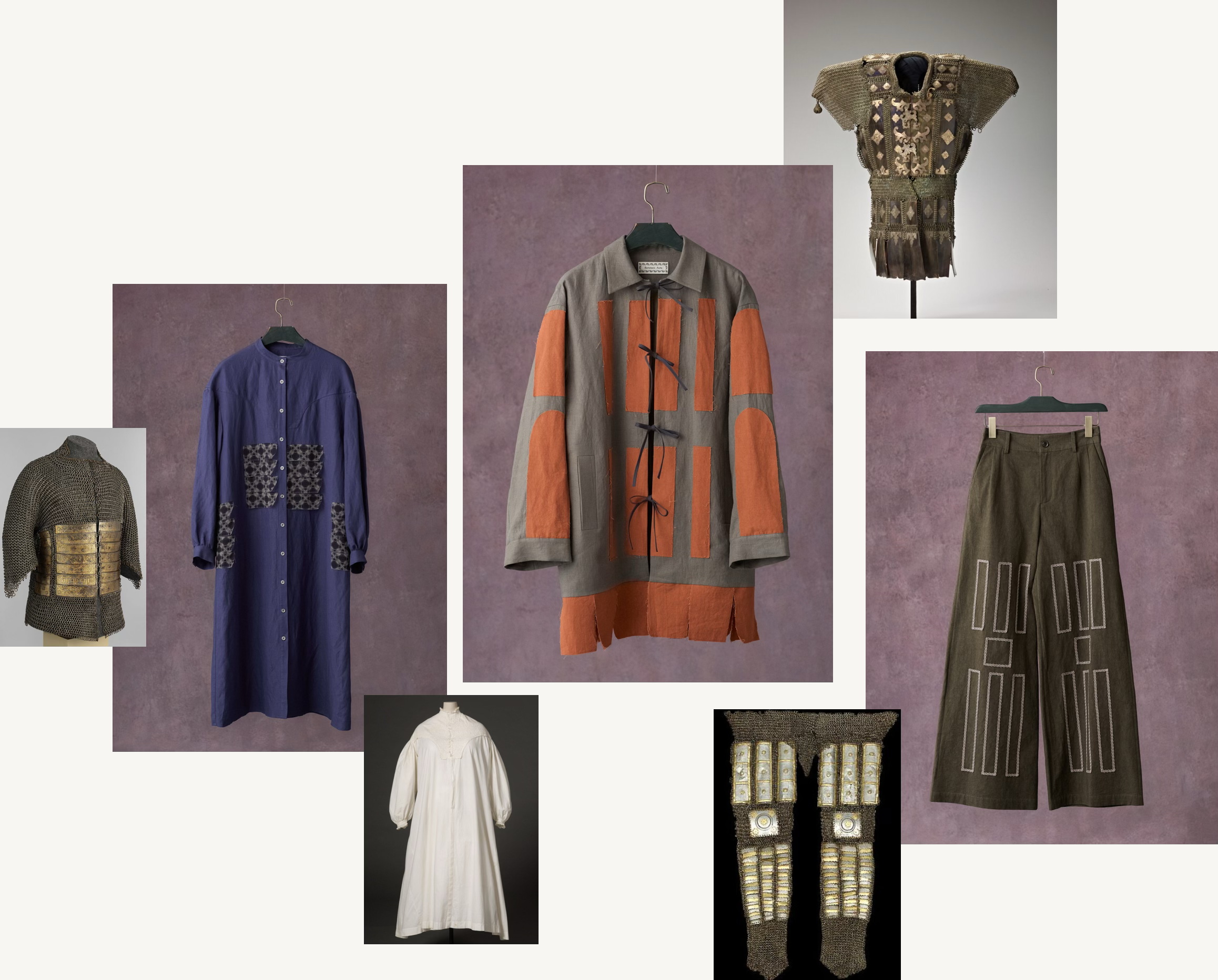
Mirror armour used metal plates to reinforce protection around the torso, with related forms found in Persia, Ottoman Turkey, Mughal India, and China. These plates, sometimes arranged as a set of “four mirrors”, protected the body’s vital areas. In the Mirror Armor Top, cotton-silk lawn patchwork takes their place on a loose cotton garment. The placement retains the suggestion of protection around the body’s core, while the light fabric gives it a delicate presence.
The tasset reference moves this attention towards the lower body: these are plates suspended below the torso to protect the upper thighs. We translated their shape and placement into satin patchwork bordered with trim on jacquard shorts. Each patch marks a small area of imagined reinforcement.
Splint
The Splint pieces begin with the idea of protection arranged in strips. On the jacket, rectangular patches of cotton-linen-ramie broadcloth sit against linen, giving the surface a segmented structure.
For the Splint Shirt Dress, we brought this reference into the more intimate language of a Victorian nightgown. Bishop sleeves and curved yokes establish a gentle silhouette, while partly attached panels of printed chiffon crepe introduce the suggestion of armour. The nightgown’s intimacy remains visible beneath this added layer.
On the trousers, narrow trim traces the outlines of protective strips across the legs. The shapes remain empty, like the shadow of armour.
Claw
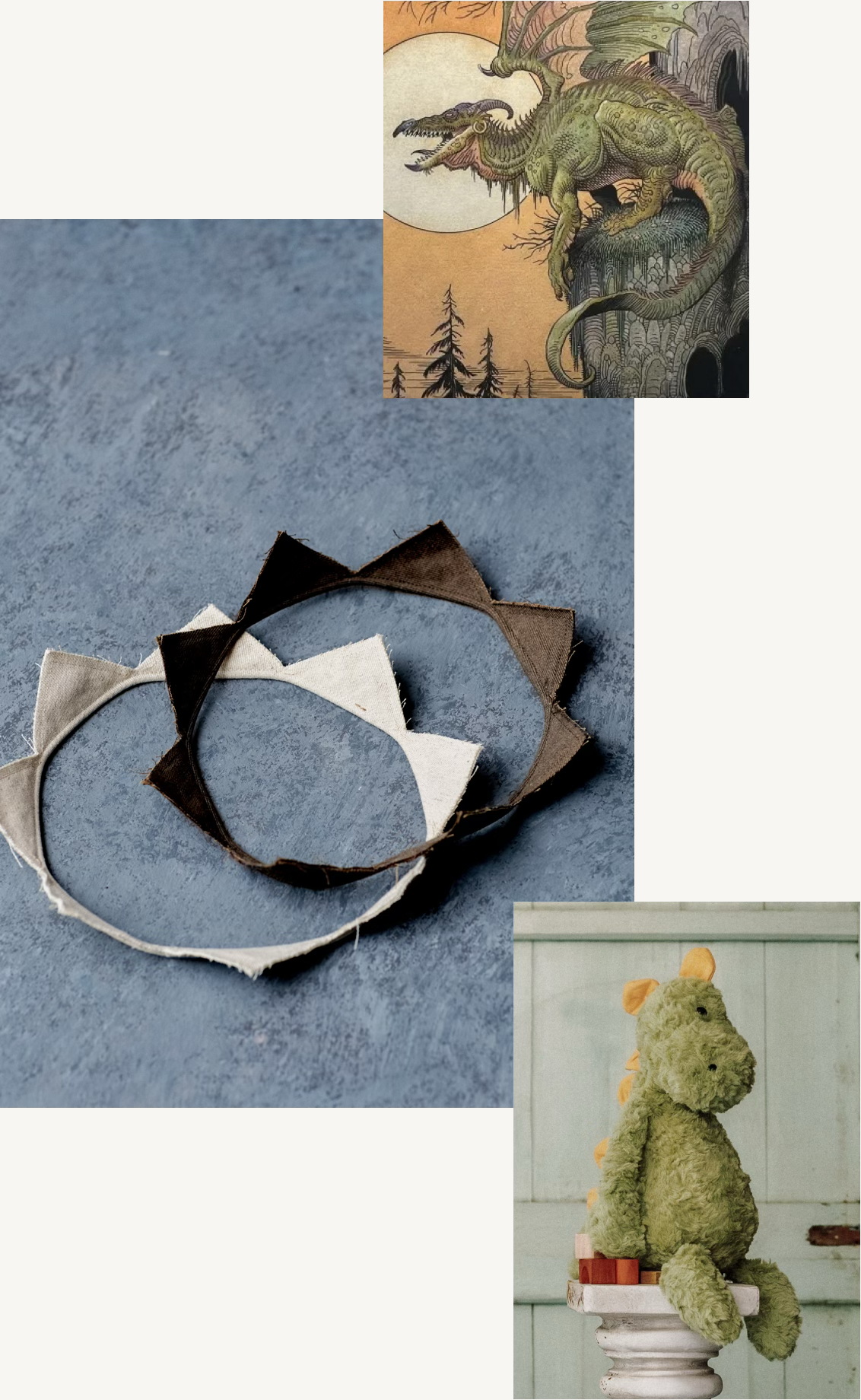
The Claw necklace comes from an imagined creature. Its pointed shapes might suggest a dragon’s claws, or the plates along a stegosaurus’s back. We liked that the reference could remain slightly uncertain, somewhere between a threatening animal and a familiar childhood toy.
Made in linen-cotton denim and finished with a waxed cotton cord, the necklace gives these sharp shapes a soft, ordinary material. There is a little bravado in wearing them around the neck. Within Armed to the Teeth, it is a small bluff carrying both the wish to seem dangerous and the tenderness that allows for connection.